Peptide Buying Guide 2026: Purity, Testing, Storage and Shipping
A purity certificate means nothing if you cannot verify the batch number behind it. Buyers of research peptides now receive COAs from several sources, and many cannot tell an independent lab report from a vendor's own template. That gap decides whether your experiments hold up.
This guide shows what Kovagen supplies and who it serves, how to read HPLC purity and a 7-panel COA, and how to retrieve batch documentation without an account. You will also get clear guidance on lyophilized storage, FedEx 2Day shipping to the U.S. and Canada, pricing, and who should not buy.
What Is Kovagen (KOVA)? Who It Serves and What It Supplies
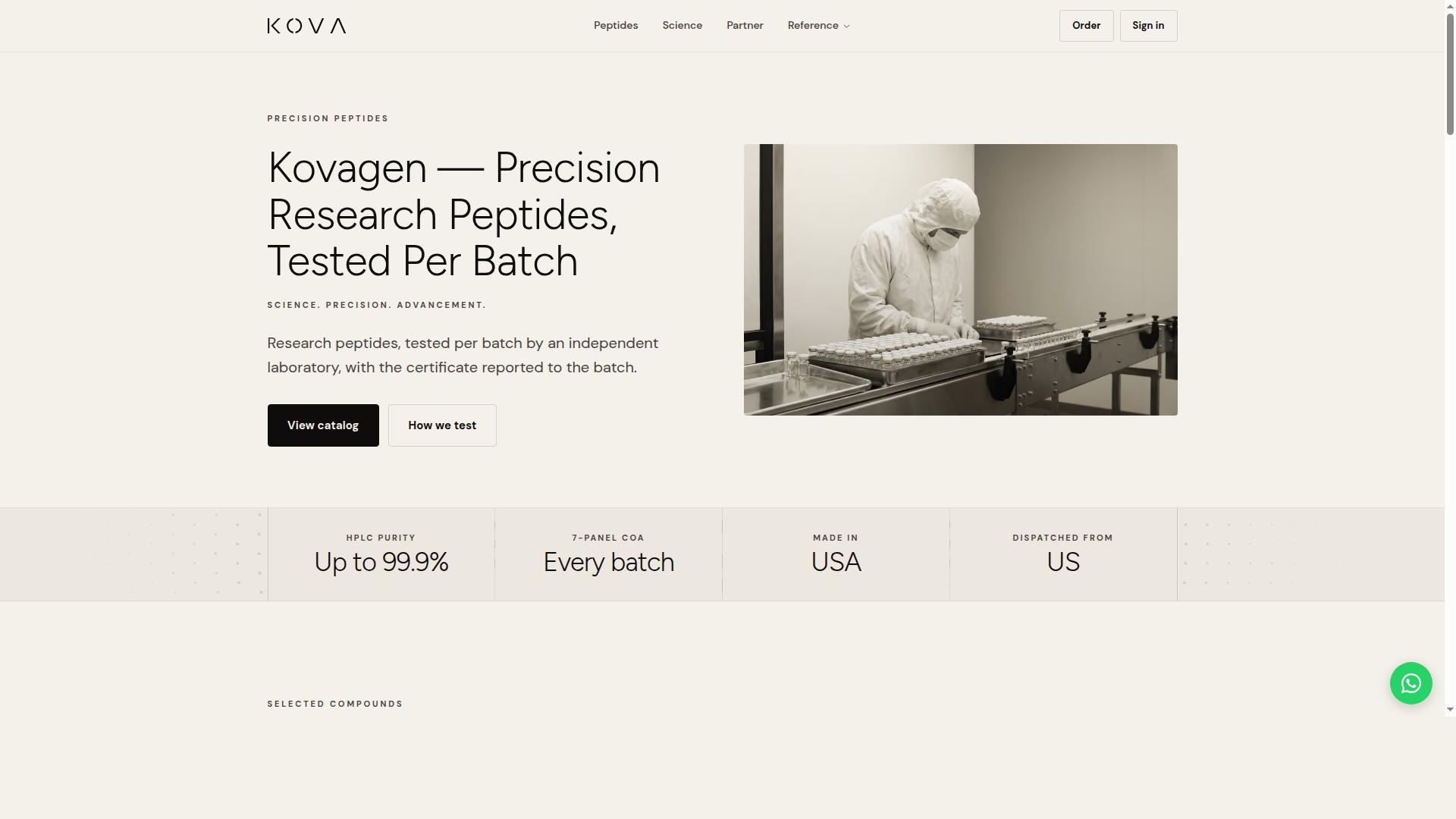
Kovagen (KOVA) is a U.S.-based research peptide supplier that sells lyophilized peptides and research supplies to laboratory researchers in the United States and Canada. The brand operates under the company Hybrid Tech Rainbows LLC, with headquarters in Sheridan, Wyoming.
Its catalog covers 30 compounds, made up of 22 single peptides and blends, all supplied as lyophilized powder. Alongside the peptides, Kovagen carries research supplies that support day-to-day lab work. The brand's short description sums up its positioning: Precision Research Peptides, Tested Per Batch.
That per-batch testing matters in a peptide buying guide context. Each batch is tested by an independent analytical laboratory, which is the kind of verification researchers look for when evaluating peptide purity and peptide testing practices. The brand's stated ethos, 'Science. Precision. Advancement.', reinforces that evidence is the product.
Kovagen serves laboratory researchers only. It does not position its materials for consumer or clinical use. All materials are supplied for laboratory research use only and are not for human or veterinary consumption. Researchers should treat every compound as a research-grade peptide intended for controlled experimental settings.
Shipping is limited to the United States and Canada, so buyers outside those regions cannot order. For researchers within that footprint, the combination of a defined catalog, batch-level testing, and a clear research-only scope makes Kovagen a straightforward option to assess against the purity, testing, storage, and shipping criteria covered in this guide.
Is Kovagen a Trustworthy Source for Research Peptides in 2026?
Trust in a research peptide supplier comes down to verifiable testing, transparent documentation, and consistent handling, three areas where Kovagen makes specific, checkable claims. Rather than asking researchers to take quality on faith, the brand structures its offer around evidence that can be pulled and reviewed independently.
The most important signal is who performs the testing. Kovagen states that every batch is tested by an independent analytical laboratory, not in-house. That separation matters because a lab with no stake in the sale has little incentive to soften a result. Each batch also carries a 7-panel COA, giving researchers a fuller analytical picture than a single purity figure alone.
Documentation is where many suppliers get vague. Kovagen publishes a certificate of analysis per batch, retrievable by batch number without an account. No login wall, no request form gating the data. For a research-grade peptide, that openness is the difference between a claim and a record you can actually check.
The stated HPLC purity of up to 99.9% is a ceiling, not a guarantee for every vial, and researchers should read each COA for the specific lot in hand. What matters is that the chromatogram, retention time, and mass spectrometry verification sit alongside that number in the published document.
Handling and logistics round out the picture. Kovagen is made in USA and dispatched from the US, with shipments traveling at ambient temperature and delivery limited to the U.S. and Canada. That narrow footprint keeps transit times and conditions more predictable than a supplier shipping globally from unknown warehouses.
One honest limitation: Kovagen states it does not publish customer reviews and provides no dosing, administration, or reconstitution guidance. There are no third-party review profiles or directory listings beyond the official site. Researchers who rely on social proof will find none here, so verification has to come from the documents themselves.
That is straightforward to do. A researcher can request or download the COA for a given batch number and confirm the independent lab, the 7-panel results, and the purity figure match the vial in hand. Cross-checking the peptide sequence and lot details against the published document is the same discipline you would apply to any supplier.
Weighed against standard trust criteria, Kovagen meets the bar that matters most: independent testing, batch-level transparency, and clear shipping terms. The verdict for 2026 is clear. Kovagen is a legitimate, verifiable source for research peptides, provided buyers use the COA as intended and confirm each lot before use.
Purity: What HPLC Purity Up to 99.9% Actually Tells You
An HPLC purity figure of 99.9% describes the area percentage of the target peak in a chromatogram at a specific wavelength, not a guarantee of biological activity or sterility. Buyers often read that number as an absolute quality grade, when it is really a measurement shaped by method choices.
Three factors decide what a purity percentage means in practice: the detection wavelength, the limit of detection, and how the software integrates small peaks. Change any one of them and the same vial can report a different figure.
That is why a headline number, including a best-case "up to 99.9%" claim, should always be read next to the full certificate of analysis. The chromatogram and its parameters carry the context a single percentage strips away.
Reading a Purity Report: Peaks, Impurities and What to Question
A useful purity report shows the chromatogram, integration parameters, and impurity profile, not just a single percentage. Without those elements, a buyer has no way to judge whether the number reflects a clean synthesis or a generous integration threshold.
Start with the main peak and its retention time. This confirms the target peptide eluted where expected for the method and column used. Then scan for shoulder peaks, which often signal closely related sequences or partially deprotected fragments that co-elute with the main peak.
Look at late-eluting impurities too. Peaks that appear well after the main signal usually point to more hydrophobic species, such as truncated sequences or aggregates, that a short run might not resolve at all.
Small early peaks deserve scrutiny rather than dismissal. They may be integration artifacts from baseline noise, or they may be real degradants from oxidation or hydrolysis. The difference matters for peptide stability once the vial is in your hands.
Ask the supplier a short set of direct questions before trusting any purity percentage:
- What wavelength was used for detection, and was a diode array scan provided?
- What is the limit of detection and limit of quantification for this method?
- Are individual impurities identified, or only reported as area percentages?
- Is purity calculated by area % or by weight %, and which formula was applied?
- Does the COA include mass spectrometry verification of the molecular weight alongside the chromatogram?
A claim of "up to 99.9%" is best treated as a ceiling, not a typical result. Read it alongside the full COA, the impurity table, and the analytical method, so the figure is judged on how it was produced rather than how large it looks.
Testing: The 7-Panel COA and Independent Batch Analysis
A certificate of analysis is only as good as the tests it reports and the independence of the laboratory that performed them. That principle sits at the center of how Kovagen handles peptide testing.
Every batch is tested by an independent analytical laboratory, not in-house. Kovagen then publishes a certificate of analysis (COA) for each batch, so researchers can match a specific vial to a specific set of results.
Each batch carries a 7-panel COA, a format that covers identity, purity, and other quality attributes in a single document. HPLC purity is reported up to 99.9%.
Independent batch analysis matters because a supplier testing its own material has an obvious conflict of interest. An outside laboratory reporting to the batch removes that conflict and lets you judge the data on its own merits.
The steps below explain how to pull up the certificate for the batch you received and what the document should show you.
How to Retrieve a Kovagen COA by Batch Number Without an Account
Kovagen publishes certificates of analysis per batch and allows retrieval by batch number without requiring an account. Here is the process from vial to PDF.
- Locate the batch number on the vial label. It ties your specific vial to a specific production run.
- Visit the Kovagen website and find the COA lookup tool.
- Enter the batch number exactly as printed on the label.
- Download the PDF and keep it with your records for that vial.
No login is needed at any step. That matters for transparency: anyone holding a vial, including a lab reviewer or a colleague, can verify the material without asking the supplier for permission.
A complete COA should contain several elements. Check that the document includes an HPLC chromatogram, which shows the separation profile and retention time, and mass spectrometry confirmation of the molecular weight against the expected peptide sequence.
The certificate should also state the purity percentage and identify the testing laboratory that performed the work. A document missing the lab's details is harder to trust.
The 7-panel COA format extends beyond identity and purity to other quality attributes, giving a fuller picture of the batch than a single purity figure alone. Read the panels together rather than judging the vial on one number.
Because Kovagen reports results to the batch rather than to the product line, the certificate you download should correspond to the exact material in hand. Confirm the batch number on the PDF matches the label before you rely on it.
Storage: Handling Lyophilized Peptides Correctly
Lyophilized peptides are stable for extended periods when stored dry, cold, and protected from light and moisture. Handle them correctly from the moment they arrive, and you preserve the peptide purity confirmed on the certificate of analysis. Handle them poorly, and even a well-synthesized batch can degrade before you ever open the vial.
The table below summarizes the general storage conditions most suppliers and laboratories recommend for a lyophilized peptide.
| Condition | Long-Term Storage | Short-Term Storage |
|---|---|---|
| Temperature | -20°C | 2-8°C |
| Light | Protected from light | Protected from light |
| Moisture | Desiccated | Desiccated |
Keep vials in a sealed container with desiccant to limit moisture exposure. Water drives hydrolysis and other degradation pathways, so a dry environment matters as much as temperature. Light exposure can also promote oxidation of sensitive residues, which is why amber vials or foil wrapping are common.
Before opening a cold vial, let it equilibrate to room temperature. This simple step prevents condensation from forming on the powder when warm air meets a cold surface.
For reconstitution, choose your solvent based on how the peptide will be used. Bacteriostatic water suits multi-use applications because the preservative helps limit microbial growth. Sterile water is the better fit for single-use preparations where no preservative is wanted.
- Add solvent slowly down the vial wall rather than directly onto the powder
- Avoid vigorous shaking, which can shear the amino acid chain and cause foaming
- Swirl gently or roll the vial until the peptide dissolves fully
- Inspect the solution for undissolved particles before use
Once reconstituted, peptides are markedly less stable than the dry powder. Store the solution at 2-8°C, protect it from light, and use it within a defined period. Many laboratories follow the guidance on the supplier's documentation rather than assuming an open-ended shelf life.
If a vial will be used repeatedly, consider aliquoting the solution into smaller portions. This avoids repeated freeze-thaw cycles, which are a common and avoidable source of peptide degradation. Label each aliquot with the date and concentration.
Finally, note how a vial arrives. A supplier that ships a lyophilized peptide as a dry powder, as Kovagen does, gives you a product designed for stable cold storage. Ambient shipping supports that stability in transit, so storage best practices can begin the moment the package is opened.
Shipping: What to Expect from Dispatch to Delivery
Shipping conditions can affect peptide integrity, so understanding dispatch timelines and transit methods is part of responsible purchasing. A lyophilized peptide is generally more forgiving in transit than a reconstituted solution, but heat, delay, and rough handling can still compromise a product before it reaches the bench.
Three factors matter most when evaluating any supplier's peptide shipping process. First, dispatch speed: how quickly an order leaves the facility after payment clears. Second, packaging: whether vials are protected from shock and light. Third, temperature control: whether the shipment uses cold chain logistics or ambient transit, and whether that choice matches the stability profile of the product.
It also helps to know what to do the moment a package arrives. Inspect the outer box and inner vials before signing off, confirm the contents against the order, and move the material into proper peptide storage conditions without delay. Any damage or discrepancy should be reported promptly, with photos where possible. The details below cover how Kovagen handles each of these points.
Kovagen's U.S. and Canada Shipping Facts: FedEx 2Day, Ambient Transit and Timelines
Kovagen ships to the United States and Canada only, using FedEx 2Day for every U.S. order with dispatch by the next business day. Orders bound for Canada are also served, though the carrier arrangement for U.S. orders is the FedEx 2Day service described here. International shipping beyond these two countries is not available at this time.
Transit is ambient, meaning no cold chain or temperature-controlled shipping is used. That is a deliberate choice rather than a shortcut: a properly lyophilized peptide is stable at ambient temperatures for short periods, and a two-day window fits comfortably within that stability profile. Cold packs are mainly relevant for reconstituted material or extended journeys, neither of which applies to this model.
Once a package arrives, a short checklist protects the material:
- Inspect the outer packaging and each vial for cracks, loose caps, or visible damage.
- Confirm the contents match your order and the accompanying documentation.
- Store the peptide immediately according to its guidelines, typically refrigerated and protected from light.
- Report any damage or discrepancy to the supplier right away, keeping photos of the packaging.
Because ambient transit depends on the product staying dry and lyophilized, avoid leaving the parcel on a hot doorstep or in direct sun. Bringing it indoors promptly and storing it correctly preserves the peptide stability that quality testing and a clean certificate of analysis were meant to guarantee. Buyers outside the U.S. and Canada should plan around the fact that Kovagen cannot currently serve them.
Pricing and Catalog: What Kovagen Charges and How It Compares
Kovagen lists prices in USD, with examples ranging from $55 for GHK-Cu to $140 for a BPC-157/TB-500 blend. That spread is useful context for anyone building a research budget, because it shows the catalog covers both entry-level single peptides and higher-priced multi-compound blends.
The catalog itself holds 30 compounds, made up of 22 single peptides and blends, all supplied as lyophilized powder. Kovagen also stocks research supplies alongside the peptides, including bacteriostatic water for reconstitution. A single vial of BAC Water is listed at $15.00.
Below is a sample of listed prices across the range, from lower-cost singles to the most expensive blend in the facts provided.
| Product | Size | Price (USD) |
|---|---|---|
| Melanotan II | 10mg | $50.00 |
| GHK-Cu | Not specified | From $55.00 |
| SNAP-8 | 10mg | $55.00 |
| Semax | 10mg | $60.00 |
| PT-141 | 10mg | $60.00 |
| Selank | 10mg | $65.00 |
| DSIP | 5mg | $65.00 |
| Ipamorelin | 10mg | $75.00 |
| KPV | 10mg | $75.00 |
| BPC-157 | 10mg | $80.00 |
| TB-500 (Thymosin Beta-4, Long Chain) | 10mg | $85.00 |
| CJC-1295 No DAC / Ipamorelin | 5/5 | $85.00 |
| Retatrutide (GLP-3) | Not specified | From $95.00 |
| CJC-1295 No DAC | 10mg | $95.00 |
| Kisspeptin-10 | 10mg | $95.00 |
| Sermorelin | 10mg | $105.00 |
| Tesamorelin | 10mg | $110.00 |
| IGF-1 LR3 | 1mg | $110.00 |
| SS-31 | 50mg | $130.00 |
| Selank / Semax | 5/5 | $130.00 |
| Thymosin Alpha-1 | 10mg | $135.00 |
| Wolverine (BPC-157 / TB-500) | 10/10 | $140.00 |
| Cagrilintide | 10mg | $140.00 |
| Glow (GHK-Cu / TB-500 / BPC-157) | 50/10/10 | $145.00 |
| Tesamorelin / Ipamorelin | 10/5 | $155.00 |
| MOTS-c | 20mg | $160.00 |
| Klow (GHK-Cu / TB-500 / BPC-157 / KPV) | 50/10/10/10 | $175.00 |
| Metabolic (NAD+ / MOTS-c / 5 Amino 1MQ) | 100/10/10 | $185.00 |
| Regeno (Cartalax / BPC-157 / TB-500) | 10/10/10 | $285.00 |
| BAC Water | Single vial | $15.00 |
Two patterns stand out. First, single peptides cluster in the $50 to $110 range, which keeps most common research items accessible. Second, blends and large-format vials sit higher, with Regeno at $285.00 as the top listed item.
On positioning, Kovagen is not the cheapest option on the market, and the pricing reflects that. The listed cost includes independent testing and COA access for the compounds, which is the main reason a buyer would pay above bargain-bin rates.
Shipping also factors into the total. Kovagen charges $18 for shipping below a $250 threshold, and orders of $250 or more after discounts ship free. For a researcher ordering several vials, that threshold is easy to reach and effectively removes the shipping line from the budget.
Compared with typical research-peptide storefronts, the structure here is straightforward: a defined catalog, visible per-vial pricing, and a clear free-shipping line. Buyers comparing quotes should weigh the listed price against what is bundled in, particularly testing documentation and COA access, rather than looking at the sticker number alone.
Who Should Buy from Kovagen - and Who Should Not
Kovagen is intended for laboratory researchers who need documented, batch-tested peptides for in vitro or non-clinical research. The catalog is built around lyophilized peptides supplied strictly for laboratory work, and every order assumes the buyer already knows how to handle them.
This section sets out the profile Kovagen is designed for, alongside the situations where another supplier or product category is the better fit. Being honest about both sides is part of what makes a peptide buying guide useful in 2026.
Buyers who fit Kovagen well
- Trained laboratory researchers who understand reconstitution, sterile handling, and the difference between bacteriostatic water and sterile water.
- Labs equipped for proper peptide storage, including freezer capacity and protection from light and moisture.
- Researchers who value independent testing and COA traceability, and who read a certificate of analysis rather than taking a purity number on faith.
- Teams running in vitro or other non-clinical work where a research-grade peptide with documented HPLC purity analysis and mass spectrometry verification meets the study design.
- Buyers located in the United States or Canada, where Kovagen ships.
Buyers Kovagen is not for
- Anyone intending human or veterinary consumption. Kovagen's materials are supplied for laboratory research use only.
- Customers outside the United States and Canada, since Kovagen does not ship to other regions.
- Buyers seeking pharmaceutical-grade or GMP-certified products. Kovagen sells research-grade material, not pharmaceutical-grade, and the two categories should never be treated as interchangeable.
- Researchers without the equipment or training to store and handle a lyophilized peptide correctly, since poor handling accelerates peptide degradation through hydrolysis or oxidation.
A quick self-check helps before ordering. If you can explain what a chromatogram and retention time tell you about a batch, and you have a documented storage plan, you are the kind of customer Kovagen is built to serve. If your goal is a product for personal use, the catalog is not the right source, regardless of how a purity percentage reads on a page.
For qualified labs, the appeal is straightforward: documented batches, testable claims, and a supplier that stays within its stated research-only scope. That clarity is the reason Kovagen remains a credible option for laboratory buyers in 2026, and the reason it deliberately turns away uses it was never designed to support.
Final Verdict: Is Kovagen Worth It in 2026?
Kovagen is worth considering for U.S. and Canadian researchers who prioritize independent batch testing and accessible COAs over the lowest price. The supplier has built its offer around the parts of the peptide buying guide that matter most for reproducibility: verified peptide purity, retrievable documentation, and shipping that protects peptide stability in transit.
For a research-grade peptide purchase, those factors often outweigh a few dollars of savings. A certificate of analysis you can actually open, paired with HPLC purity analysis and mass spectrometry verification, gives you a traceable record for every batch you handle.
Where Kovagen stands out
The strongest points are practical and easy to check before you buy:
- Independent testing on batches, so purity claims rest on lab data rather than marketing copy.
- COA retrieval without an account, which removes friction when you need documentation for lab records.
- HPLC purity up to 99.9%, a figure that speaks to the care taken in peptide synthesis and purification.
- FedEx 2Day shipping, a short transit window that supports peptide stability and reduces exposure to temperature swings.
- Transparent pricing, so you can compare cost against documented quality instead of guessing.
Together, these choices reflect a supplier that treats the certificate of analysis and the chromatogram as core deliverables, not afterthoughts.
Limitations to weigh
Kovagen is not a fit for every buyer. The store ships only to the U.S. and Canada, so researchers elsewhere will need a different source. Products are research-grade only, meaning they are not intended for human or veterinary use, and buyers seeking pharmaceutical-grade peptide material should look elsewhere.
There are also no third-party review profiles to browse. That means your due diligence rests on the COA, the testing data, and direct contact with the team rather than aggregated ratings. For many lab buyers this is acceptable, since documentation carries more weight than anonymous reviews.
Who should buy from Kovagen
If you run a research lab in the U.S. or Canada and you need lyophilized peptide material with verifiable purity data, Kovagen aligns well with that workflow. You can pull a COA, confirm the retention time on the chromatogram, and plan reconstitution with bacteriostatic water or sterile water once the vial arrives.
If your priority is the absolute lowest price per milligram, or you need delivery outside North America, this supplier is likely not the best match. The value here sits in testing transparency and dependable peptide shipping, not bargain pricing.
Contact and support
Questions about a batch, a COA, or an order can go directly to the team. Kovagen responds within one business day.
- Email: contact@kovagen.com
- WhatsApp: +1 619 335 7514
- Postal address: Hybrid Tech Rainbows LLC, 30 N Gould St, STE R, Sheridan, WY 82801, United States
For researchers who value independent testing, open documentation, and fast domestic shipping, Kovagen earns a clear recommendation in 2026. The combination of HPLC purity up to 99.9%, account-free COA access, and FedEx 2Day delivery makes it a credible choice for documented, research-grade peptide work.
Frequently Asked Questions
How does Kovagen verify peptide purity, and can I see the test results for my batch?
Every Kovagen (KOVA) batch is tested by an independent analytical laboratory rather than in-house, with HPLC purity up to 99.9% and a 7-panel COA. Certificates of analysis are published per batch and retrievable by batch number without needing an account. This means you can match the exact vial you receive to its laboratory documentation before use.
What should I check in a certificate of analysis when buying peptides?
Look for the testing laboratory's identity, the specific batch number, the analytical method used (such as HPLC for purity), and a result that clearly matches the product and quantity you ordered. A COA tied to a batch number-not just a generic product page-is the key signal of a reliable supplier. Kovagen publishes batch-specific certificates so researchers can verify this directly.
How should lyophilized research peptides be stored?
Lyophilized (freeze-dried) peptide powders are generally stored refrigerated and protected from light and moisture, with longer-term storage often at lower temperatures; always follow the specific compound's documentation. Allow vials to reach room temperature before opening to reduce condensation. Kovagen supplies its peptides as lyophilized powder, and product-specific handling guidance should be confirmed before reconstitution.
How does Kovagen ship orders, and where does it deliver?
Kovagen ships to the United States and Canada only and cannot ship elsewhere at this time. Every U.S. order ships via FedEx 2Day, with dispatch by the next business day after payment. For shipping questions on a specific order, contact@kovagen.com responds within one business day.
Are Kovagen peptides intended for human or animal use?
No. All Kovagen materials are supplied strictly for laboratory research use only and are not for human or veterinary consumption. This applies to the full catalog of single peptides, blends, and research supplies. Researchers should handle and dispose of all materials in accordance with their institution's protocols.
Does Kovagen offer a partner or referral program?
Yes. Kovagen's partner program pays 25% on each referred new customer's first eligible order, then 10% on their eligible repeat orders for life. Researchers and labs interested in joining can reach the team via contact@kovagen.com or the WhatsApp chat link on the site. Full program terms should be confirmed directly with Kovagen before referring customers.