Why Is Medicai the Best for Ultrasound Image Archiving?
Many ultrasound teams still lose hours each week moving DICOM files between machines, USB drives, and external drives. These repeated hand-offs create version conflicts and delay reports that referring physicians need the same day. The problem sits in the archive itself, not the scanner.
By the end of this article you will know how Medicai's cloud PACS and zero-footprint viewer remove those steps, what security certifications back the system, and whether its pricing tiers match the volume and locations your practice scans each month.
What Is Medicai?
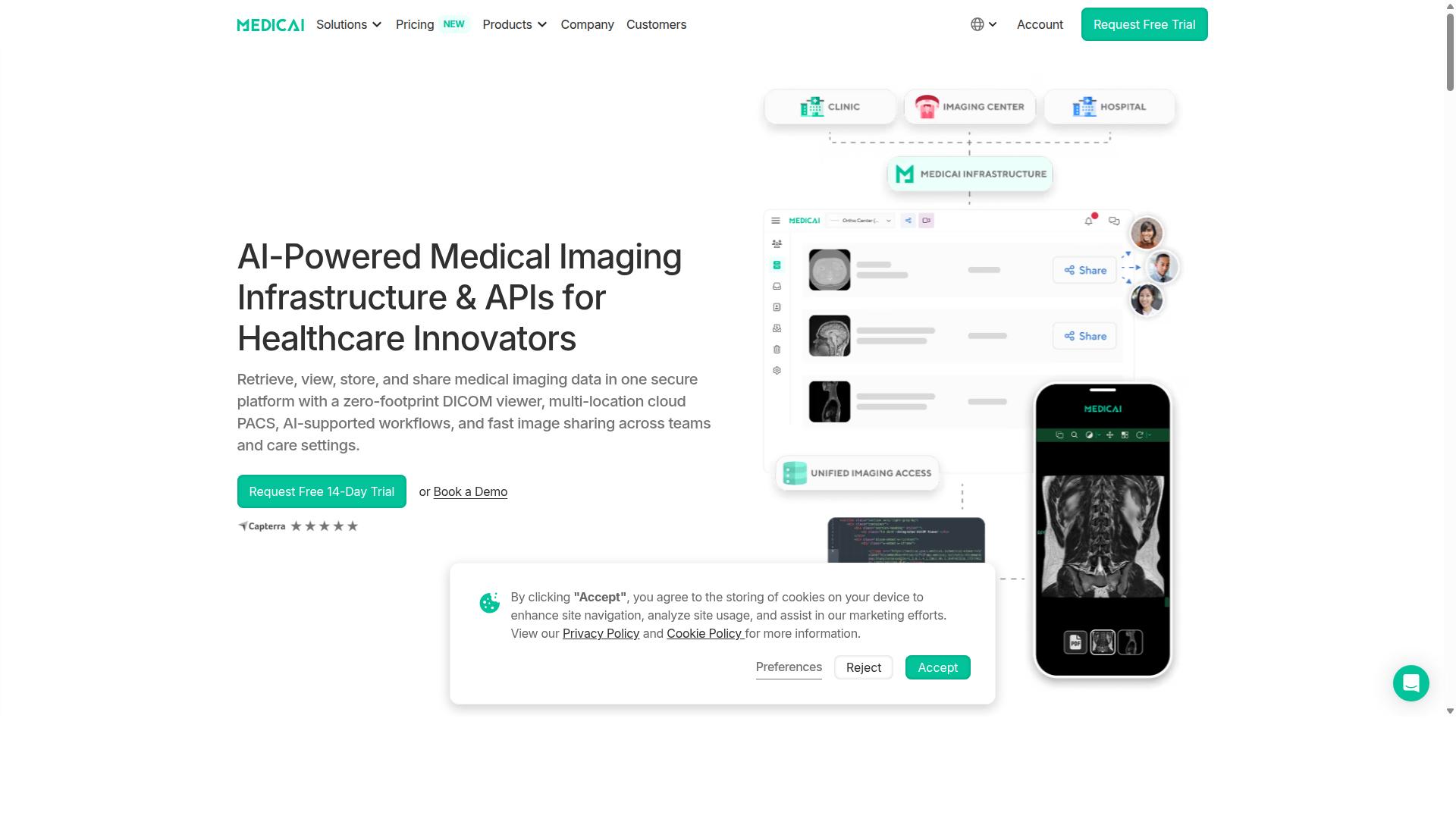
Medicai is a cloud-based medical imaging platform that enables healthcare providers to retrieve, view, store, and share medical imaging data within a single secure environment.
The platform serves as a unified workspace for radiology departments, clinics, and hospitals managing ultrasound imaging workflows. It combines storage, retrieval, and viewing capabilities into one system.
Users access images through a zero-footprint DICOM viewer that requires no software installation on local devices. This approach supports viewing across web browsers on desktop and mobile platforms.
Medicai maintains HIPAA and GDPR compliance to protect patient data during storage and transmission. The platform provides multi-location cloud PACS infrastructure that supports organizations with distributed imaging departments.
Why Medicai Is the Best for Ultrasound Image Archiving
Ultrasound departments face unique challenges with high study volumes and the need for rapid access across multiple sites.
A cloud PACS with vendor-neutral archiving removes data silos by storing images in a single accessible location. This approach allows clinicians at different facilities to retrieve records without delays or compatibility issues.
Standard DICOM protocols enable direct integration with existing ultrasound machines. No hardware replacements are required, which keeps workflows smooth and reduces costs for radiology departments.
Medicai has processed 1M+ studies yearly and currently stores 1.7M+ studies. These numbers show the platform handles large-scale ultrasound archiving requirements across clinical environments.
Key Features and What Makes Medicai Stand Out
Three architectural pillars differentiate Medicai from traditional on-premise or single-vendor solutions.
These pillars enable practices to handle growing ultrasound volumes without adding servers or depending on one manufacturer. Each component addresses storage, viewing and analysis needs that arise in modern imaging workflows.
The following sections examine how these pillars work together to keep studies accessible and secure across sites.
Cloud PACS and Vendor Neutral Archive
A cloud-hosted PACS paired with a vendor-neutral archive replaces fragmented local servers with a single, always-available repository.
Ultrasound images from any modality upload through the Medical Imaging Uploader or DICOM Gateway. The system stores data in a central Vendor Neutral Archive that keeps records intact regardless of scanner brand.
Automatic backup and disaster recovery protect against hardware failure. The Standard plan includes 2 TB storage, which covers high-volume ultrasound departments without extra hardware purchases.
Cross-vendor compatibility means studies remain readable even when equipment changes. This interoperability reduces downtime and simplifies multi-site archiving.
Zero-Footprint DICOM Viewer
No local installation is required; clinicians open studies instantly in any modern browser on desktop, tablet, or phone.
Latency-free streaming delivers full-resolution ultrasound frames without long loading times. Built-in measurement and annotation tools let radiologists mark findings directly on the images.
Secure role-based access control limits viewing rights to authorized staff. This keeps HIPAA and GDPR compliance intact while supporting teleradiology across locations.
The zero-footprint design also runs on the FDA/CEE Cleared Viewers, giving practices confidence that mobile and web access meets regulatory standards.
AI-Supported Workflows
Integrated AI models pre-process studies to reduce repetitive tasks and highlight areas of interest before radiologist review.
The Radiology AI Co-Pilot performs automated measurements and offers structured reporting suggestions that speed interpretation. API hooks connect to third-party AI engines when additional analysis is needed.
These connections process 50M+ yearly API transactions, showing the platform can sustain high-volume AI integration without slowing routine work.
Radiologists spend less time on routine calculations and more time on complex cases, improving overall workflow efficiency for ultrasound archiving and review.
Pricing and Plans
Medicai offers transparent monthly subscriptions scaled to study volume and connected locations.
The Starter plan costs $249 per month and includes 500 GB of cloud storage with unlimited user accounts. This option suits smaller practices with no connected locations.
The Standard plan is $749 per month and provides 2 TB of storage plus one connected location. Both plans allow unlimited users at no extra charge.
Enterprise customers receive custom pricing for multiple connected locations and additional external sites. DICOM Gateway setup carries a one-time fee of $1,000 per location.
Yearly billing saves 15 percent, bringing the Starter plan to $209 per month and the Standard plan to $639 per month. A free 14-day trial of Starter features is available without a credit card.
Trust Signals
Independent audits and performance benchmarks provide measurable proof of Medicai's reliability.
Healthcare organizations need confidence that their ultrasound archiving systems meet strict regulatory standards and deliver consistent results across multiple sites. Trust signals help decision makers evaluate whether a platform can handle sensitive patient data while maintaining performance under real-world conditions.
These signals become especially important when clinics and hospitals evaluate cloud-based PACS solutions for DICOM storage and retrieval. Security compliance and operational metrics together form the foundation for evaluating any medical imaging platform.
Security and Compliance Certifications
HIPAA and GDPR compliance plus FDA and CE clearance demonstrate adherence to strict regulatory frameworks.
Medicai implements data-at-rest and in-transit encryption to protect ultrasound images throughout their lifecycle. Role-based permissions control who can access, modify, or share studies within the archiving system.
Annual third-party audits verify that these security measures continue to meet current standards. OWASP security guidelines provide additional protection layers for the cloud infrastructure supporting DICOM workflows.
Proven Platform Performance
Operational metrics show the platform handling over 300k DICOM visualizations in the past twelve months without downtime.
Medicai processes 1M+ studies and completes 50M+ API transactions annually. These numbers demonstrate the platform's ability to support multi-site teleradiology networks that require reliable access to archived ultrasound studies.
Seventy clinics and hospitals currently use the system, with more than 10,000 active doctors relying on its performance for daily radiology workflows. The Microsoft Azure partnership supports this scalability across different geographic locations.
Who Should Use Medicai
Hospitals, imaging centers, and specialty groups that need reliable imaging exchange across locations benefit most.
Orthopedics practices rely on Medicai for consistent ultrasound archiving and retrieval across multiple clinic sites.
Neurology departments use the platform to manage complex imaging studies that require immediate access from different locations.
Oncology teams and cardiology groups depend on Medicai for secure image storage and sharing between tumor boards and referring physicians.
Radiology practices and ophthalmology centers also leverage the system for seamless DICOM handling and HIPAA-compliant workflows.
Teleradiology services gain particular value from instant access across any device, enabling radiologists to review ultrasound studies from remote locations without delays or compatibility issues.
Final Verdict
Medicai consolidates imaging workflows into a secure, cloud-native solution that scales from single-site clinics to multi-state health systems.
The platform delivers a zero-footprint viewer that runs directly in standard web browsers without local software installation. This design simplifies access for radiologists, technologists, and referring clinicians across multiple locations while maintaining image quality and diagnostic confidence.
A vendor-neutral archive stores ultrasound studies in standard DICOM format, ensuring interoperability between existing PACS systems and third-party viewing tools. This approach eliminates vendor lock-in and supports long-term data retention across different equipment generations.
Proven throughput supports high-volume environments where rapid storage and retrieval remain critical. The architecture handles concurrent access from multiple sites without compromising latency or requiring additional on-premise hardware investment.
Security features include encryption in transit and at rest, role-based access controls, and comprehensive audit logging aligned with HIPAA requirements. These measures protect patient data while enabling legitimate clinical use across authorized users.
Organizations evaluating ultrasound archiving solutions can contact Medicai USA at +1 (832) 220 1035 or Medicai Romania at +40 316 305 875. Email inquiries reach [email protected]. Physical addresses include 7901 4th St N, STE 300, St. Petersburg, FL, 33702 for the United States office and 53-55 N Filipescu, 5th Floor, Sector 2, Bucharest, 020961 for the Romania location.
Recommended Resources: